
How to calculate ground sample distance for UAV photogrammetry
GSD is one of the most important parameters when formalising the specifications for a photogrammetric project. Many decisions depend on the chosen GSD, such as:
- What altitude to fly for safety and coverage.
- What will be the data resolution of the flight.
- How to set up the camera for the expected resolution and accuracy.
- What level of detail can be achieved.
- How to plan flight paths to ensure sufficient image overlap and coverage.
- How to comply with project specifications or regulatory requirements for mapping accuracy.
- How to balance flight time, battery usage, and data quality.
Understanding of GSD helps optimize flight planning and data quality of the collected data.
Introduction
Ground Sampling Distance determines the amount of ground or surface area covered by a drone image.
GSD is expressed in mm per pixel, or cm per pixel. Lower GSD, means the object will be reproduced with higher resolution, and vice versa. For example, if the GSD is 2 cm, each pixel in the image represents a 2 cm × 2 cm area on the ground. If the GSD increases to 10 cm, each pixel covers a 10 cm × 10 cm area, resulting in less detail and lower resolution.
GSD calculation
There are a variety of methods for the computation of the mean GSD for an image, which try to balance between precision and speed of computation. The rigorous computation of the mean GSD on an image requires the evaluation of the ground projection for each pixel over the digital terrain model.
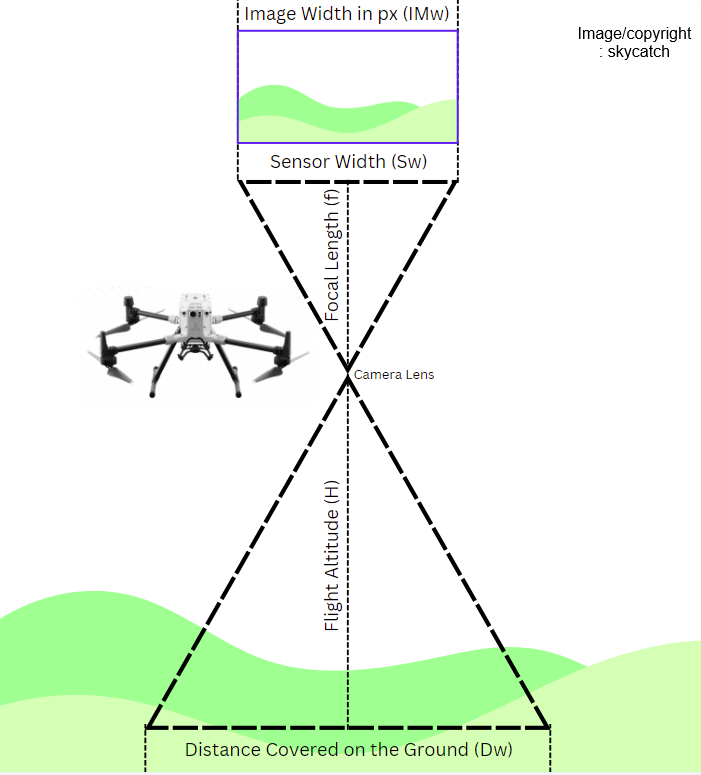
Simlified computation of the GSD follows a simple product that relates the pixel size on the image and the image scale. For a predefined focal length of the digital camera, the flying height has to be set up to guarantee the GSD on the ground.
The required flying height and photo scale of the planning mission depend on two basic parameters once the end product is defined: required resolution and accuracy on the ground.
It is calculated using the following formula (1): GSD = (PS × D) / F
where:
- GSD = ground sample distance (mm per pixel)
- PS = physical size of one pixel on the sensor (mm)
- D = distance to target structure i.e. Altitude in mapping missions and horizontal distance in vertical inspection missions (m)
- F = lens true focal length
After calculating the GSD, one can calculate the baseline distance (BD) between camera positions to achieve the desired image overlap (OF).
The BD formula ensures that each successive image covers enough of the previous image to maintain the required overlap. It is computed via:
BD = W × (1 - OF %/100)
In the formula we need to know the image footprint, which is obtained from: W= (D/F)* SW
Where:
- BD = distance between camera positions (m)
- W = ground width covered by one image (m)
- OF = desired image overlap
- SW = physical width of camera sensor (mm)
Discussion
The highest possible GSD for aerial surveys depends on several factors such as the image exposure interval of the camera and the blur due to the image motion.
As the ground terrain and the image are rarely parallel, and the ground cover is undulated or rough, the GSD does not stay constant throughout the whole image. The GSD variation in magnitude is a scale problem. In other words, the computation of the GSD requires the knowledge of the topography of the surface to compute rigorously the values all over the digital terrain models (DTMs). Most organisations or compa- nies have accurate DTMs at different resolution levels (or can order them). Alternatively, the DTM can even- tually be downloaded from the web (e.g. SRTM 90 m DEM, CGIAR 2008) despite its resolution.
The above formulas actually compute the mean GSD per image, as the central point of the image is projected onto the ground. This approach does not take into account the whole DTM but particular samples, normally one or two, the pattern of points selected to compute the mean GSD plays an essential role in combination with the topography of the area. The planning of the photogrammetric flight missions over tilted or mountainous areas should consider a minimum of 3×3 GSDs per image. Nevertheless, special care should be taken to confirm that the overlaps are guaranteed when the GSD is decreased more than the allowed deviation of 10 %.
Calculating GSD for UAV flights varies slightly as compared to calculating it for capturing vertical facades. Sometimes it is important to set the Distance to the object D, variable as the farthest point away from the camera that one wants to survey, instead of the object closest to the camera. By doing so, one will ensure that the point farthest away from the camara will still have sufficient resolution for digital reconstruction purposes. If one sets GSD at the closest object, then details of the farther object will not be displayed with the same accuracy.
Online calculators
References
Subscribe and receive updates, lessons, courses and more. No spam!
Get the latest updates and tips.